commands sent end to end to benchmark my thesis architecture
5,000,000
reliability with CAN at every tested command rate
>99.9%
layers from ROS topic to motor: application, gateway, motor control
3
projects across robotics, embedded systems, research and software
7
Why I do this
Robots should be practical enough to use, reliable enough to trust, and safe enough to work beside people.
Intelligent
Systems that perceive and adapt, not only repeat.
Reliable
Behaviour you can predict, measure and debug.
Safe
Designed for spaces shared with people, with functional safety in mind.
That standard is set where software stops being abstract: in motor currents, sensor noise, bus timing and safety limits. My work is to carry ideas across that line and make them hold up in the real world, so that robotics becomes more accessible and more useful to the people it works with.
What I do
RoboticsRobotics
Robotics & intelligent automation
ROS 2 architectures that turn intent into coordinated motion, from gripper control to navigation and human-robot interaction.
ROS 2 robotic software
Intelligent gripper architectures
AI-powered and humanoid robot applications
Robot navigation and human-robot interaction
Industrial automation and functional safety
EmbeddedEmbedded
Embedded systems & hardware integration
Firmware in C and C++ on ESP32-S3 and STM32: motor control, sensor feedback and the buses that hold a system together.
C/C++ embedded software
ESP32-S3 and STM32 integration
Motor control and sensor feedback
CAN, UART and Ethernet
Hardware-software integration
SoftwareSoftware
Software engineering & applied projects
Python for data and signal processing, TypeScript and React for interfaces: the tooling that makes hardware observable and usable.
Python engineering applications
JavaScript, TypeScript and React
Signal processing and statistical analysis
Academic and applied projects
How I got here
Trichy7,600 kmStuttgart
1 2018, Trichy
It started with electronics.
I studied Electronics and Communication Engineering at Saranathan College of Engineering. Circuits, embedded systems and connected devices gave me the fundamentals. An IoT internship and a smart agriculture system built for the Smart India Hackathon gave me a first taste of building things that sense the world.
2 The turning point
Then one question took over.
What happens at the point where software meets the physical world? Following that question led me to robotics and intelligent automation.
3 2023, Stuttgart
A move of 7,600 kilometres.
I moved to Germany for a Master's in Electrical Engineering at the University of Stuttgart, focusing on robotics and embedded systems.
4 2023 to 2025
Software first.
I joined Pilz GmbH & Co. KG as a software developer, building frontend components in React and TypeScript. At the university I built the interface of the SynTrac Ergometer App, and designed a flow-controlled experiment on slide electrification, with Python doing the signal processing and statistics.
5 2026
A gripper, end to end.
My Master's thesis: a ROS 2 software architecture for an intelligent gripper in construction robotics. Three layers, from a ROS topic on the host down to the motor, tested with 5 million commands.
6 2026
Back to Pilz, for the robots.
As a robotics and functional safety intern I researched and designed AI-powered humanoid robot applications for industrial automation, bringing together machine vision, robot navigation and functional safety for real manufacturing scenarios.
7 Now
From the pins up.
I focus on intelligent robotics, embedded software and industrial automation. I like problems where several disciplines meet, and I am happiest when I understand a system from the pins up to the behaviour.
What I bring to a team
Analytical, adaptable, and comfortable on both sides of the hardware-software line. Select a pin to see where I have used it.
Robotics
JDJannifer DurairajanRobotics & embedded systems engineer
Embedded
Software
Pin description
ROS 2Robotics
A ROS node takes commands on /gripper_cmd and publishes force, position, speed, torque and status back to ROS.
Master's thesis, 2026. University of Stuttgart, IAS with IWB Construction Robotics
A ROS 2 software architecture for an intelligent gripper
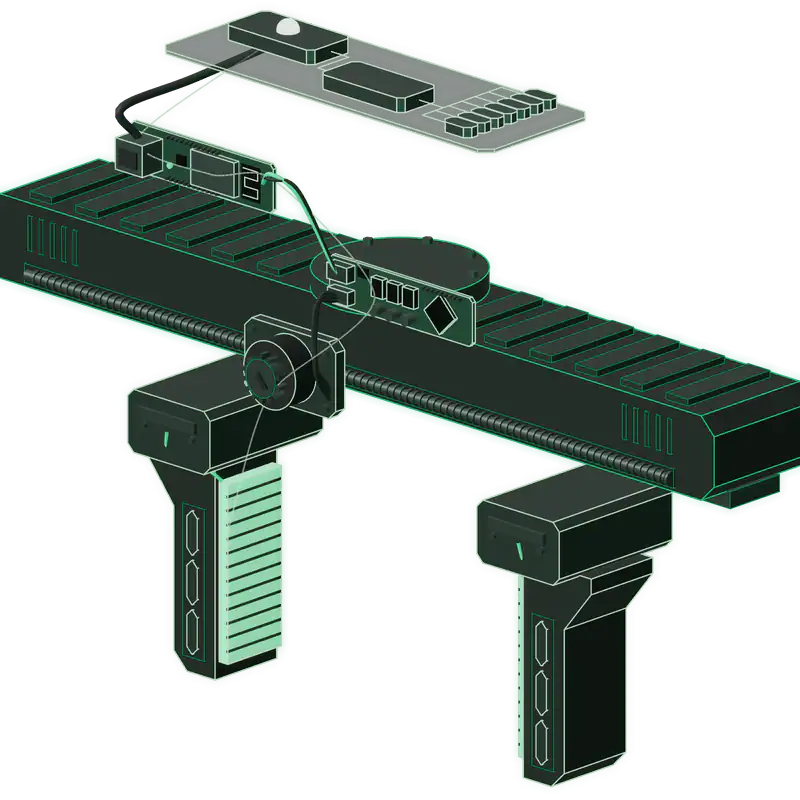
Construction robots handle heavy, irregular building materials, and the gripper is where they meet the world. I built the software that connects a ROS 2 application to the gripper's embedded controllers, then measured how well the link holds under load.
A ROS node takes commands on /gripper_cmd: open, close, stop, home, set speed, position or torque. A gripper driver packs each one into a compact binary packet.
Carries commands from the host to the gripper and feedback back, reliably and in order.
Receives packets over TCP and forwards them to the motor controller. A protocol abstraction interface puts UART and CAN behind one API, so the bus can be swapped with minimal change. It also reads the force sensor.
Both links were implemented between gateway and motor controller, so they could be compared on the same hardware.
Firmware on an STM32G431 executes the motor action and returns acknowledgement and status. Back on the host, feedback is published to ROS as force, position, speed, torque, status, acknowledgement and error topics.
Across 5 million command transmissions, CAN held above 99.9% reliability with almost no timeouts. UART was faster, but its reliability fell as the command rate rose. CAN was selected.
Researched and designed AI-powered humanoid robot applications for industrial automation, bringing machine vision, robot navigation and functional safety together for real manufacturing scenarios.
Designed a flow-controlled experiment to study how droplet velocity affects slide electrification, measured with a flowmeter, oscilloscope and current amplifier, and analysed in Python.
Python, instrumentation, signal processing, statistics
Developed the user interface of the SynTrac Ergometer App in JavaScript and improved its usability and frontend functionality.
JavaScript, UI development
Built frontend components with HTML, CSS, JavaScript, TypeScript and React, with a focus on usability, performance and maintainable code.
React, TypeScript, JavaScript, HTML, CSS
Applied supervised learning and remote-sensing methods to Landsat imagery to detect changes in water, urban and forest cover, using image segmentation and NDVI.
Supervised learning, remote sensing, NDVI
A smart-agriculture concept that estimates soil-fertility conditions in real time from soil and air moisture sensors on a NodeMCU, with an app that shows the readings and recommendations.
Sensors, NodeMCU, IoT
Let's buildsomethingthat moves.
I am open to roles, research collaborations and interesting engineering projects in robotics, embedded software and automation.